The "Black Hole Star": A Dark Sun Seen Through an Energy Lens
When a Black Hole Becomes a Star
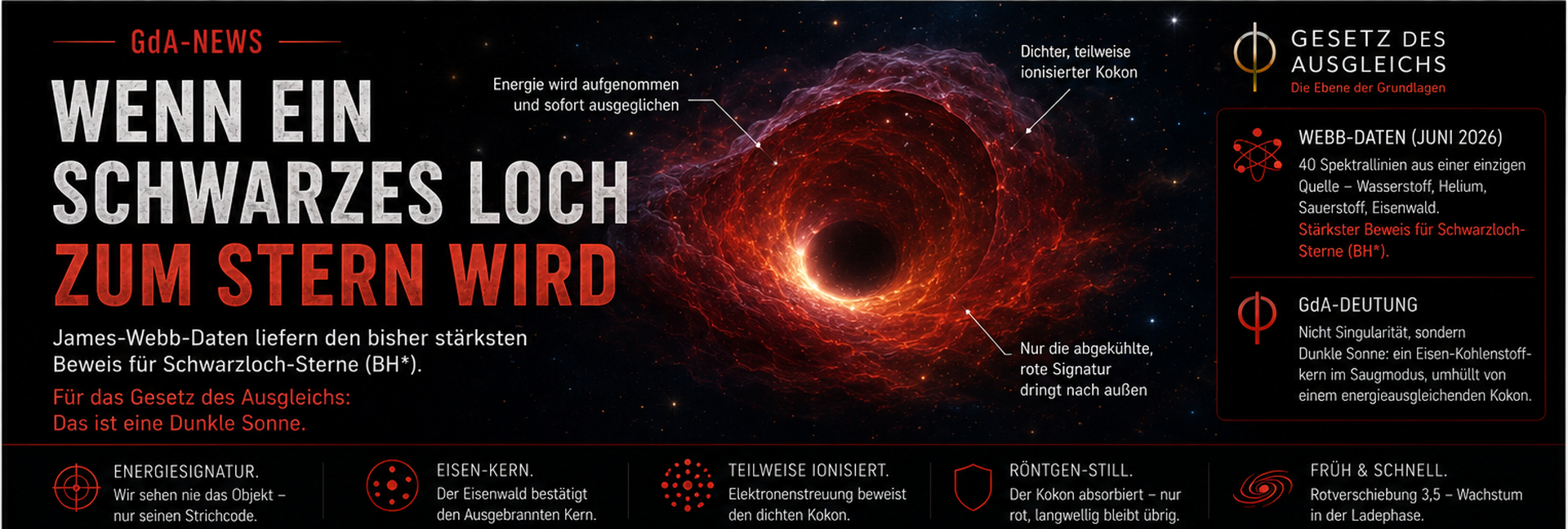
Since 2022, the James Webb Space Telescope has been finding puzzling "Little Red Dots" in the early sky — tiny, deep-red points of light that already appeared around 600 million years after the Big Bang. In June 2026, the team around Vasily Kokorev (UT Austin) delivered the strongest evidence so far of what they are. On the basis of the deepest spectrum ever measured of such a point — more than 40 spectral lines from a single tiny source — NASA officially calls the object a black hole star (BH): a black hole wrapped in a dense cocoon of partially ionized* gas that swallows the light from near the hole and gives it back off red and long-wavelength. Kokorev's conclusion: "Everything fits, nothing is broken."
Anyone who knows the Law of Equalization reads no riddle here, but a description. This is exactly a dark sun.
What We Are Actually Seeing
Before we interpret the core, it is worth looking at what we actually hold in our hands: a spectrum. Not an image of the object, but lines. In the Law of Equalization this is the decisive point — we never see the object itself, always only its energy signature. Energy receives an imprint from every piece of matter it touches: an exact copy of what is going on inside that matter, a kind of barcode. Our eyes, instruments and spectrographs can do only one thing — read out this barcode, and from it we read off material, strength, distance. The 40 lines — hydrogen, oxygen, helium, the "iron forest" — are this barcode, not the core. We never smell the substance, only its smell; we never see the dark sun, only the pattern its energy carries.
The Dark Sun, Point by Point
In the Law of Equalization, a dark sun is not a tear in spacetime and not a singularity. It is the bare, burnt-out core of a star — a gigantic lump of iron and carbon, the material that on Earth too soaks up energy instead of throwing it back. An empty sponge in absorption mode. And the spectrum confirms it point by point:
The iron forest — sixteen iron lines that the team itself christened that way — requires a high-energy source. The iron core that the Law of Equalization has been describing for years stands in the light. The lines of hydrogen, oxygen and helium explicitly do not fit a simply rotating gas cloud; the best model needs a broadening by electron scattering — the hallmark of a dense, layered, energy-charged shell. Helium shows up in fluorescence and in absorption, a dense medium around a strong source. And the object sits in the early universe (redshift 3.5, around 1.8 billion years after the Big Bang) and grows faster than the theoretical limit allows — the charging phase, in which a dark sun fills up before it ignites as a bright sun.
Why the Cocoon Stays Black
Here it gets interesting, because by now astrophysics describes the mechanism itself — only in different words. The high-energy radiation from near the core partially ionizes the atoms in the gas cocoon: it tears electrons out, charges the matter up. But the gas density is so extreme that the atoms immediately capture the electrons again — recombination. That is exactly why, alongside the emission lines, there are also lines of neutral atoms that would not exist at all in a fully ionized gas. The inner cocoon is "optically thick": it absorbs and shields off a large part of the high-energy radiation.
In the Law of Equalization this is energy dominates energy, followed by immediate equalization. The high-energy wave hits the dense matter, charges it up — and the matter equalizes again instantly. What is left over and gets out is no longer the high-energy wave, but its long-wavelength, red remainder. That is the whole "blackness": not a hole that swallows everything, but matter that absorbs the wave and lets only the cooled-down signature through. That is exactly why these objects are silent in the X-ray range — astrophysics says it explicitly: the X-ray radiation is absorbed in the dense cocoon.
The Mass That Was Only an Interpretation
A second point falls almost by the way. Because the line broadening is now attributed to electron scattering and no longer to the rotational velocity of the gas, the black hole no longer has to be nearly so massive to produce the same broad lines — the estimated mass drops significantly. With that, the old riddle of how black holes could become so massive so early dissolves in passing: they never had to. In the Law of Equalization this is no surprise. Mass is a relational value, a value of interpretation — not an absolute value that sits inside the object. If the assumption about what broadens the lines changes, the mass changes. It was never a property of the hole, but a result of our calculation.
The Tool Is the Same Error
This object could be seen at all only through a "gravitational lens": the foreground galaxy cluster Abell S1063 concentrates the light and amplifies it — 30 hours of Webb time effectively became 80 through the lens. NASA itself calls it nature's magnifying glass. In the image you see short, curved red arcs around the cluster — distorted, magnified background galaxies.
But a lens focuses through its material — it does not bend empty space. A mass concentration concentrates the energy, because energy always orients itself on matter. And the arcs that we see as curvature are not bent space: they are the rays that come too close to the foreground matter, just barely miss it, and fly on to us displaced inward — with the correct information, only shifted. Einstein predicted this effect and was honored with the Einstein cross. He described the optics correctly — but not the process behind it. The cause is always the same: energy.
Observation and Interpretation
The clean separation remains important. The spectrum, the partially ionized cocoon, the electron scattering, the iron forest, the X-ray weakness, the amplification by the foreground — that is measured, shared fact. The singularity in the core and the curved spacetime are the interpretation that is laid over it. And astrophysics leaves the door open itself: Kokorev says that a black hole is indeed held to be the source, but that other explanations are being discussed as well; in a year or two we will know more.
The Law of Equalization reads the same observation differently: an underloaded dark sun with an iron core, a cocoon that takes up the energy and equalizes it, and a matter lens that concentrates energy. No tear in spacetime, no invisible particle, no invented entity. Only energy, matter and equalization.
This is not a quarrel against the data. The data are moving in this direction all by themselves.