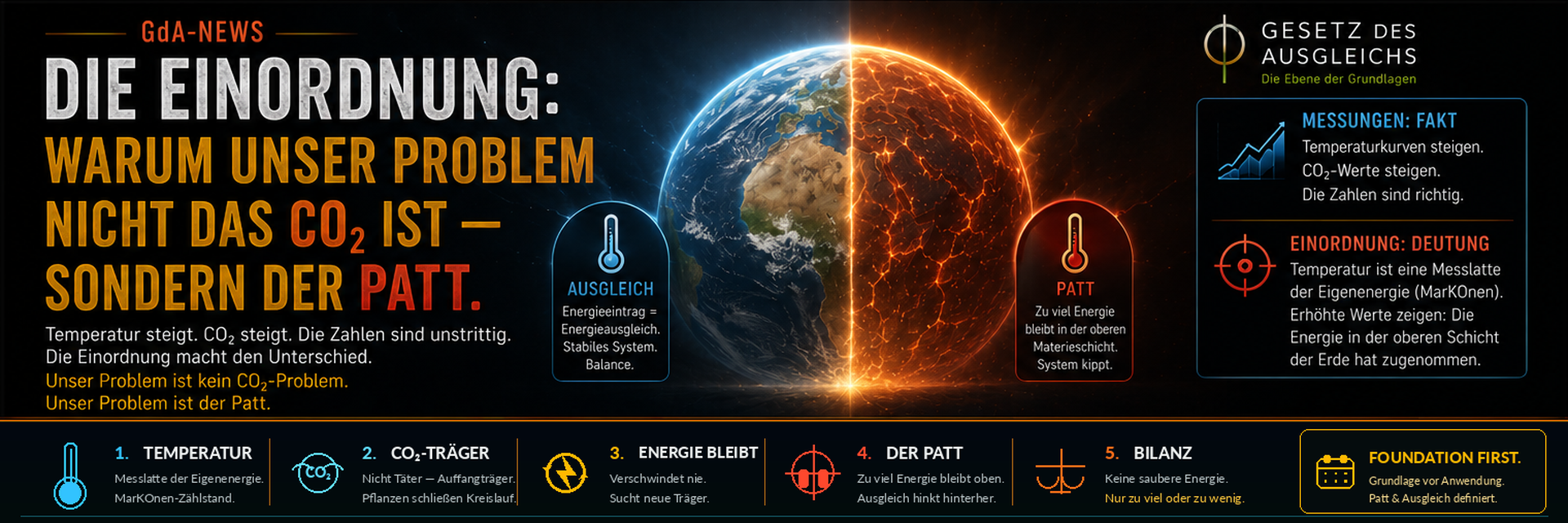
The Reframing: Why Our Problem Is Not CO₂ — but the Stalemate
The measurement curves are undisputed: global temperature is rising, CO₂ levels are rising. Nobody is contesting the numbers — the Law of Equalization does not either. The question the Law of Equalization asks is a different one: what does temperature actually count?
Temperature is a count
In the Law of Equalization, temperature is not an independent quantity but a yardstick of intrinsic energy: it shows the MarKOn count of matter — how much energy a carrier is currently holding. The new MKn converter in MarKOS makes this readable: the melting point of a material marks 100 % of its intrinsic capacity. Above that, matter leaves its solid form. Tungsten, the element with the highest melting point, crowns the scale.
Apply this classification to the Earth and the direction of view tips over: the increase of global temperature shows how strongly the amount of energy in the Earth's upper layer of matter has grown.
Where the energy comes from
For centuries humankind has taken energy from ever deeper, ever more strongly compressed carriers: first wood, then coal and oil from the upper layers — then, with nuclear fission and nuclear fusion, from matter compressed so strongly that the smallest volumes release enormous amounts. For the balance sheet it makes no difference which layer the energy came from: the released amount is the same, and after use it ends up in the great collecting basin of the upper matter — our habitat.
Because energy does not disappear. Never. After use it looks for new carriers.
The stalemate
And this is where the fundamental law takes hold: only as much energy can leave the Earth as the superordinate system permits across the boundary surface. For millions of years the Earth stood in an energy balance — the amount of energy per area and volume differed between the layers, but measured against total volume and density the system was in equalization. Whoever changes this ratio tips the equilibrium. The symptom of this tipping is what we today call "global warming" or "climate change".
Hence the classification: our problem is not a CO₂ problem. Our problem is the stalemate.
CO₂: not the culprit, but a receiving carrier
At this point the misunderstanding about "clean" energy also dissolves. The Earth does not care whether the energy sits in CO₂ or somewhere else. We consider CO₂ an exhaust gas — when in fact we can be glad it is there: if we did not have it, the energy we release from fossil matter and other sources would have to look for other carriers after use.
We have broken the cycle in two places: we have reduced the number of plants that push the energy from CO₂ back into O₂ — and we release more energy than equalization has time to find new carriers for evenly. The consequences show up where free energy finds the fastest alternative: at the poles. They were energy-poor for a long time, because the energy had its carrier deep inside the Earth — from where we have been extracting it in vast amounts for centuries. For free energy, ice is the best fast carrier. It melts, sea level rises.
The consequence
From this follows the sentence that re-sorts the entire debate: there is no clean or dirty energy. There is only too much or too little.
Nuclear fusion too, regarded as the clean energy source of the future, changes nothing about the balance sheet — the released amount ends up in the same collecting basin. Humankind does not have an energy shortage problem. It has an energy understanding problem. And that is showing itself right now in real time: in individual US states, data centers already consume more energy than is available for everyone; energy is being redistributed from people to technology, and the first protests are on the street. Whoever does not understand the energy cycle cannot use it efficiently — no matter how many new sources they tap.
Calculation and interpretation
As always: the measurements remain untouched. Temperature curves, CO₂ levels, radiation balances — the numbers are the work of the researchers and retain their validity. The Law of Equalization examines the level above: the interpretation of what is being counted. And as with the material finding "thinner = stronger", the foundation came before the application: the two base positions, stalemate and equalization, and the redefinition of temperature were formulated before they were applied here to the Earth. Foundation first.