No Mini Big Bang Needed — Black Hole, Gravity and the Gravastar in the Light of the Law of Equalization
What a black hole really is, why gravity is not a pull — and why the "gravastar" from Frankfurt asks the right question but gives the unnecessarily complicated answer
An article from the perspective of the Law of Equalization (LoE)
What this is about
In June 2026, two theoretical physicists at Goethe University Frankfurt, Daniel Jampolski and Luciano Rezzolla, announced a new solution to Einstein's field equations. Their statement: when a massive star collapses at the end of its life, the result does not necessarily have to be a black hole. An extremely compact object can form instead, which they — in the tradition of Mazur and Mottola (2001) — call a gravastar.
The remarkable thing about it is not the name. The remarkable thing is what this gravastar no longer contains: no singularity (no point of infinite density) and no event horizon (no boundary behind which physics stops). And what it needs instead in order to stay stable is the actual point of contention of this article: a "mini Big Bang" arising in its interior, whose expansion — driven by dark energy — is slowed down and pushed into an equilibrium by gravity.
The direction is right. Only the means is too complicated. And in order to show why, we have to keep three things apart that established physics mixes together: what a black hole really is, why gravity is not a pull, and why we find the one so hard to see and the other so hard to grasp.
1. The right question — asked by established physics itself
For over a century, the black hole was regarded as a compelling consequence of Einstein's equations: matter collapses, curves space infinitely deep, and at the centre a singularity remains — a place at which all physical laws, including relativity itself, lose their validity.
That is not an elegant end point of a theory. That is a declaration of bankruptcy at precisely the point where the theory is supposed to explain the phenomenon. When the mathematics spits out "infinite", it is not saying "here is the truth", but "here my model ends".
The Frankfurt work openly acknowledges this. Singularity and event horizon are treated as what they are: a nuisance one would rather be rid of. And this is exactly the insight the Law of Equalization has been putting forward for years: there is no singularity. A black hole is not a region in which space and time tear apart, but a perfectly ordinary body of matter in a particular energetic state.
That established physics is now itself beginning to throw singularity and event horizon overboard is not a defeat for the Law of Equalization — it is a confirmation of its thrust. The question "What if it isn't a hole at all?" is now officially open for discussion. The difference lies solely in the answer.
2. What a black hole really is: the dark sun
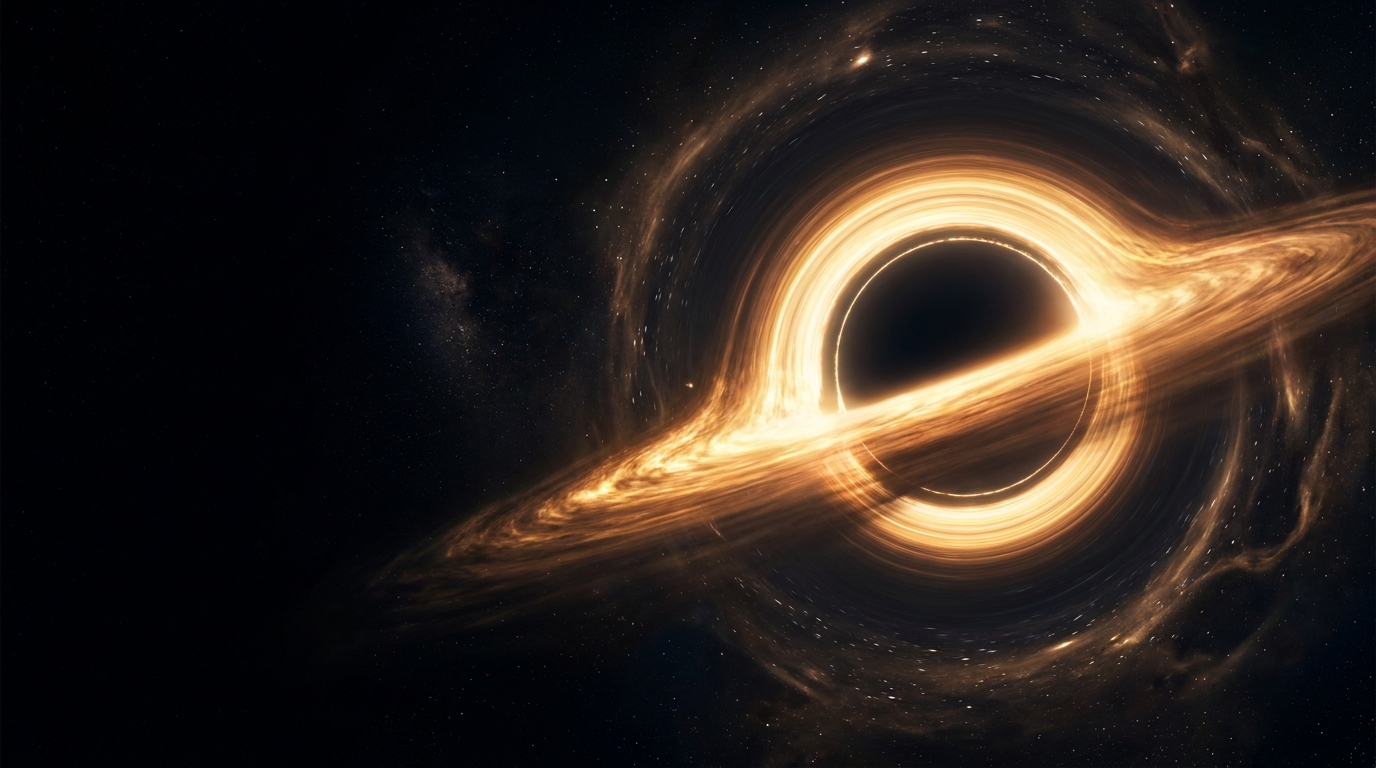
In the Law of Equalization, what we call a "black hole" is a dark sun: a massive body of matter at the absolute zero point of radiation, but at the maximum of readiness to absorb. No hole, no maw, no tear in spacetime — but rather the most complete, emptiest sponge in the cosmos, which absorbs every arriving amount of energy in order to equalize its own deficit.
It consists for the most part of what today's science takes to be "dark matter" — and in the Law of Equalization that is not an exotic particle, but simply energy-poor matter: carriers without active energy coupling. Invisible, structure-forming, and visible only when it begins to take on energy. Where very large quantities of it come together, that is enough to form a dark sun — which is the case at the centre of every galaxy.
Black sun and bright sun are not two different things here, but the same substance in different charge states — like ice, water and steam. The bright sun at the centre of the solar system releases energy (charged above 100 %, it is overflowing). The dark sun at the centre of the galaxy absorbs energy (far below 100 %, it is charging). We look at a "white hole" every day — our own sun. We just don't call it that.
3. Why we don't see them: the one-way street principle
Here comes the point at which most people get stuck: why do we see a cold stone on Earth, but not a gigantic dark sun in space?
The answer lies in an iron rule of equalization: energy always moves from the object with much energy and little matter to the object with little energy and much matter. In some cosmic systems this equalization runs in only one direction.
On Earth we see the cold stone because energetic "traffic" prevails all around — ambient light, photons bounce off and come back to us. There is oncoming traffic, because the medium is dense enough.
The dark sun, by contrast, is the absolute extreme: gigantic matter at the energetic zero point, the largest existing basin for energy, in an almost empty space. Every energy wave that hits it is equalized without remainder in this matter medium — it goes in and does not come back. A one-way street into the battery. Without a returning signature, our telescopes stay blind. We see only black.
That is the decisive error of perspective: we are looking against the direction of flow. The energy flow goes only inwards, and we are looking from outside against it. We see a "hole" where in truth the densest matter in the universe is waiting as a gigantic battery. Exactly like a hole in the ground — that too is not a tear in reality, but simply the place from which no information comes back.
4. Why gravity is not a pull — and the 180° question
Now to gravity, the second great misunderstanding. It seems so incomprehensible to us only because we experience it from a perspective that deceives us.
In the Law of Equalization, gravity is not a pull from a point, but pressure from a surface. The pressure comes from the superordinate system — from outside, from all sides. And that applies at every scale: the universe presses on the galaxy, the galaxy on the solar system, the solar system on the planet, the planet on the human being, the human being on his cells, the cell on the atoms. The pressure always comes from outside.
Here lies the reason for the apparent 180°. From an observer's point of view, what matters is where he stands in the system:
- The pressure from space acts 360° on the solar system and concentrates on the centre.
- But a person on the Earth's surface is not at the centre. Half the Earth lies between him and the centre.
- That is why he experiences the strongest resulting force as a 180° fan from above, towards the centre. The other half is the matter lying in between — that is the "moon effect".
The digging test makes it tangible: you get downwards by clearing matter away (digging a hole) — because your own intrinsic energy and the energy of the matter above you add up to the force that pushes you towards the centre. Upwards it is not that simple, because there it is not only the thin air acting, but the entire matter of the solar system standing against you. And this works exactly up to the centre — from there on everything reverses. Then you would have to take on the entire energy of the matter plus that of the solar system.
At the exact centre, all pressure forces equalize each other. No resulting force = no measurable mass. That is the reason why a dark sun (as well as our bright sun, the Earth's core, every galactic centre) has a mass = 0: it is itself the reference point, the centre, it is not competing between two boundaries. In the Law of Equalization, mass is not a property of an object, but a measured value for the resistance an object produces between two reference points — mass = resistance = R, as in an electrical circuit.
5. How the galaxy shapes the dark sun
This also makes clear what actually holds the dark sun together and gives it its shape — and here no internal drive is needed.
Because in charging or equalization mode all energy from the surroundings travels in only one direction — into the centre of the galaxy —, it is the galaxy itself that presses the dark sun into its shape. The inward-directed pressure of the superordinate system, acting from all sides, presses the energy-poor matter into a sphere, keeps it compact, gives it its form. Not some inner something pressing outwards — but the outside pressing inwards.
That is exactly the point at which the Law of Equalization and the gravastar part ways. The Frankfurt physicists need a mini Big Bang in the interior, pressing outwards, in order to catch the collapse. The Law of Equalization does not need it, because the shaping and stabilizing pressure comes from where it comes from in every stable system in the world: from outside, from the superordinate system. No second universe in the interior needed — only the one universe outside, which is already there anyway.
6. The lightning bolt: when energy does escape after all
Sometimes we do perceive an energy spike from dark suns. In the Law of Equalization that is not a contradiction, but is explained like a lightning bolt on Earth.
A lightning bolt arises when enough tension builds up between two poles and the distance becomes small enough — as with a high-voltage line, where from a certain proximity of the contacts the equalization jumps across through the air. Energy finds its way as soon as the charge carriers in between are dense enough.
With a dark sun, in rare cases exactly the same thing happens: if another object with even more matter and proportionally less energy happens to be favourably placed at the right distance, and the charge carriers between the two are dense enough, a flashover occurs. Part of the energy goes via the photons — and energy in photons becomes visible. That is what we perceive as a lightning bolt. These are the rare energy spikes that we register from dark suns every now and then — no mystical radiance out of nothing, but a cosmic overvoltage flash following exactly the same principle as the thunderstorm over our heads.
The same principle explains the hot edges of some galaxies: excess energy that has found no further carrier, collects at the edge and becomes visible there through its number of photons.
7. The superfluous step: why no mini Big Bang is needed
Now the core of the objection can be summed up cleanly.
In order to catch the collapse, the Frankfurt solution needs an additional, specially introduced source: a mini Big Bang inside the star, driven by dark energy, which presses outwards and thus balances the inward collapse. The object thereby becomes a nested matryoshka doll — inside a gravastar there is supposed to be another gravastar.
That is elegant mathematics. But it is an unnecessary construction. It solves a problem that only exists because another error of thinking was not corrected: the assumption that the pressure has to come from inside.
Remarkable is the choice of words of the Frankfurt physicists themselves. Their mini Big Bang is slowed down by gravity and pushed into an equilibrium. Pushed, not pulled. That is no coincidence, but mechanical necessity: an outward-pressing expansion cannot be held in equilibrium by attraction — attraction would contract it further. Only a counter-pressure holds it in suspension. The model forces the authors into the language of pressure, even though their formal framework continues to describe gravity as curvature and attraction. The old label is still stuck on the door, but the description behind it is already pressure mechanics — exactly what the Law of Equalization puts forward as its basic principle.
8. Comparison
| Question | Gravastar (Frankfurt) | Dark sun (Law of Equalization) |
|---|---|---|
| Singularity? | No (correctly recognized) | No |
| Event horizon? | No (correctly recognized) | No |
| What keeps the object stable and in shape? | Internal mini Big Bang, driven by dark energy, pressing outwards | The galaxy itself — external pressure of the superordinate system, pressing inwards |
| Pressure or pull? | "pushed" (in the mechanism), but formally still curvature/attraction | Pressure, consistently and as a basic principle |
| Additional constructs needed? | Yes: mini Big Bang + dark energy + nested matryoshka structure | No: only the superordinate system that is present anyway |
| Why invisible? | Externally indistinguishable from the black hole (left open) | One-way street: we are looking against the direction of flow, no signature comes back |
| What is the object? | A new, exotic type of object | A familiar sun in a different charge phase |
9. Conclusion
The Frankfurt work is progress — but only half of it. It asks the right question and draws the right first consequence: singularity and event horizon are thrown out. With that, established physics is approaching a position that the Law of Equalization has held for years.
Where it stops short is the decisive second step. Instead of dissolving the error of thinking completely, it merely swaps one construct (singularity) for a new one (mini Big Bang plus dark energy plus a nested inner world). It takes out one phantom and puts in another — because it holds on to the basic assumption that the stabilizing pressure has to come from inside, and because it continues to think of gravity as a pull instead of as pressure.
The Law of Equalization does not need this detour. A black hole is a dark sun — energy-poor matter at the zero point, which we fail to see only because we are looking against the direction of flow of the one-way street. Gravity is not a pull from a point, but pressure from a surface, out of the superordinate system. And it is the galaxy itself that presses the dark sun into shape — no inner mini universe, no matryoshka, no additional energy source. In rare cases it discharges like a lightning bolt when the conditions are right, and precisely then we see it briefly flare up.
You don't have to invent a second universe in order to explain a black hole. You only have to stop taking it for a hole — and start looking against the right direction.
Reference: D. Jampolski & L. Rezzolla (Goethe University Frankfurt), solution of Einstein's field equations for gravastars, 2026. — Sources of the Law of Equalization: Principal Theorem 7 (Gravity as pressure equalization), Principal Theorem 10 (Black/White holes as charge states), "Pressure Force & Nested Systems" and "Mass as a Relational Value" (gesetz-des-ausgleichs.de).