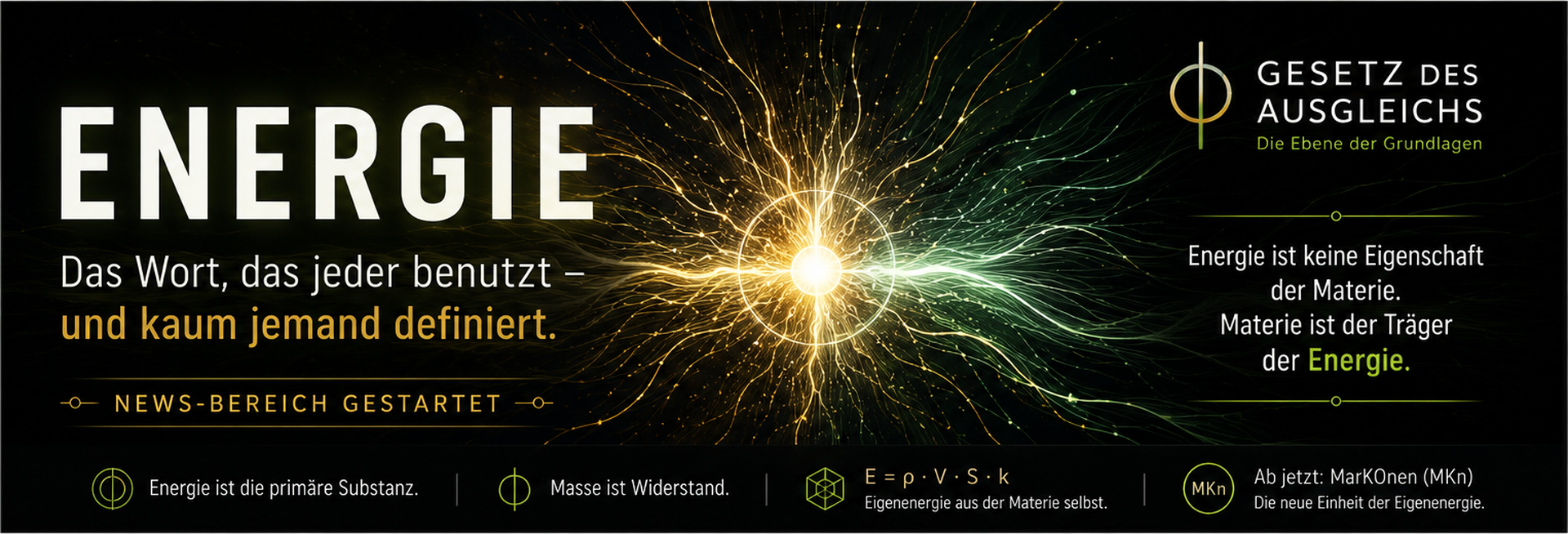
What Energy Really Is — and Why It Is Counted in MarKOns from Today
To open the news section: the Law of Equalization explains the term everyone uses and hardly anyone defines — and gives energy a unit of its own.
An article from the perspective of the Law of Equalization (LoE)
A word everyone uses
"Energy" is on the electricity bill, in the granola bar, in the physics lesson. We pay for it, eat it, measure it — and when you ask what it actually is, the room goes quiet. The usual answer: the capacity to do work. That describes what energy does, not what it is.
The Law of Equalization turns the question around.
Energy is the first thing, not the second
In the LoE, energy is not a property of matter — it is the primary substance, and matter is only its carrier. Not "mass becomes energy", but: energy is always there, and matter is the form in which it happens to be bound. The underlying principle is plain: Energy always dominates energy. What happens when two things meet is decided by which of them has the higher energy — not by "force", "hardness" or "momentum". Those are just different names for one and the same thing.
And mass? It is only the resistance
Here lies the greatest misunderstanding physics carries around with it. Einstein all but equated mass and matter; ever since, some say "matter is energy", the others "mass is energy". Both turn it on its head.
Mass is not a building block of energy. Mass is resistance — a relational value that arises only in comparison. Imagine stepping between two people who are fighting. How much "mass" you have in that moment depends on how strong the two of them are: if one is stronger, he pushes you towards the other, and what acts between you — that is the mass. The same with the scale — it measures your weight from below. If gravity were a pull from within, you would have to hold the scale above your head. It stands beneath you because the pressure comes from outside; mass is what sets itself against that pressure.
That is why a planet in a foreign star system can be larger and denser than Earth and still have less mass — because mass depends on the relation in which it is measured.
The formula: energy out of matter itself
How much intrinsic energy is in a thing? The LoE calculates it from the properties of matter:
E = ρ · V · S · k — density times volume times stability (how firmly the structure is bound) times material capacity (how much the atom of the substance can hold).
The comparison with Einstein is instructive. In E = m · c² there is c², a fixed conversion factor for the entire universe. In the LoE, S · k stands in its place — the same kind of quantity (energy per mass), but material-specific instead of universal. Einstein takes one constant for everything; the LoE says it depends on the substance. Symptom against cause.
The birth of the MarKOns
And that brings us to a small but overdue matter. The world has invented a good dozen units for energy — joule, calorie, electronvolt, kilowatt-hour, erg. All of them names for the same thing, a different one for every trade.
If energy is recast in the Law of Equalization — as primary substance, not as a derivative of mass — then it may also have a unit of its own. As of today, intrinsic energy in the LoE is counted in MarKOns (MKn), named in the same family as MarKI and MarKOS. Whoever redefines a quantity may set the unit — physics has done exactly the same with every other unit.
Why right now
Because the building blocks fit together. A 2026 materials study found that ultrathin materials become stiffer the thinner they are — because the structure has no room left to give way. Across chemically completely unrelated substances, with the researchers' conclusion: "Geometry becomes more important than chemistry." That is exactly the structural factor — the S in the formula — that the LoE had named months earlier. The foundation stood first, the finding came afterwards.
That is the stuff this news section is made of: not against physics, but one level below it — where the foundations lie.
More on the formula and its evidence: gesetz-des-ausgleichs.de/docs/theorie/formeln. The Law of Equalization is published on Zenodo (CC BY-SA 4.0).